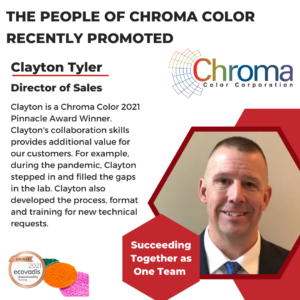
Chroma Color® Corporation Promotes Clayton Tyler to Sales Director

Chroma Color® Corporation, a leading specialty color and additive concentrate supplier, has continued to grow sales year over year. With this accelerating growth, Chroma Color® has strengthened the sales organization in order to provide our best resources to support and enable our continued growth and future market expansions.

Chroma Color® is pleased to announce the promotion of Clayton Tyler to Sales Directors role. Clayton will report to Bishop Beall, VP of Sales & Business Development. Clayton will be responsible for Sales Director for the Eastern Region and support our Healthcare focused initiatives. In addition, he will assist in executing Chroma Color®’s growth strategy, managing, and coaching of his sales team, and providing enhanced service to our customers.

“Over the past couple of years Clayton has demonstrated the leadership, business acumen, product expertise, and industry knowledge necessary to effectively lead our sales team and equipping our sales personnel with the right tools to deliver the best color & additive concentrate solutions for our customers. His leadership will contribute to Chroma Color®’s competitive advantage, especially during these challenging times,” states Bishop Beall, VP Sales & Business Development.  “If you are currently looking for new coloring methodologies or are facing challenges that need to be solved, our sales team is ready and well equipped to deliver those solutions and to serve you with excellence.”

Bishop Beall continues: “We are very excited that we were able to find great sales director talent such as Clayton within our own organization who can support our sales team and customers in finding the best color concentrate solutions for their business. We are looking forward to their continued success and positive influence on our business.”

Chroma Color®:

Chroma Color® Corporation is a leading specialty color and additive concentrate supplier serving diverse markets, including wire and cable, packaging, healthcare, pharmaceutical, consumer products, and others.

With the recent acquisition of Epolin, Chroma Color® is now the recognized leader in the near-infra-red (NIR) absorptive dye industry, producing proprietary blends to suit the eye protection and light management sectors.

Chroma Color®’s growth strategy includes robust organic and inorganic growth through nine acquisitions over three years. Chroma’s extensive technical leadership and manufacturing expertise, coupled with its game-changing colorant, has delighted customers for over 50 years.

D6 Lowers Cost and Improves Retail Shelf Appearance with Support from Chroma Color®’s Technical Team

D6 Inc., founded in 2014, has become the fastest design-to-shelf packaging manufacturer globally by transforming the packaging industry through transparency in the recycling chain.

D6 has a solid network for a circular economy that takes waste and diverts it from landfills and up-cycles it into new containers, parts, and other products that go into consumers’ households or added to retail shelves. In addition, D6’s PCR (Post-Consumer Recycled Content) meets food-grade requirements and can create other kind of products.

The Challenge

One well-known fact for brands using recycled materials…they can have a slight gray tint, black spec, or other minor blemishes that can impact the look on shelves. To eliminate any negative perception from consumers, D6 reached out to Chroma Color® Corporation for a solution. D6 chose a slight blue tint color concentrate to help the PCR thermoformed clamshell products look great on the shelves.

D6 was pleased with the results, but after some discussion, they wanted to see if Chroma Color® could meet some new goals:

  • Reduce cost through lower let-down ratios
  • A lower amount of inventory needed to have on hand for production
  • A reduction in overall Labor cost
  • Lower transportation cost and carbon footprint
  • Lessen the overall environmental impact of the products produced

The Solution

Chroma Color®’s technical team evaluated the current situation. They recommended the company’s environmentally friendly G-Series after some discussion and analysis.

By making the switch over to the G-Series for use with PCR, D6 was able to:

  • Produce PCR package that still looks great on retail shelves
  • Reduce production cost by lowering let-down rates by 1/3
  • Process products at a much lower temperature, thus decreasing overall energy cost
  • Lower freight cost by 1/3 due to smaller shipments sizes
  • Use less color concentrate
  • Reduce labor costs during shipping and processing
  • Lower some warehouse storage needs
  • This extra warehouse space could also provide for excess inventory during times of short supplies
  • Lower carbon footprint

Summary

By switching to the G-Series for PCR, D6 reduced cost, made the production of their containers simpler, and lowered their carbon footprint.

“D6 appreciated the time and effort of the Chroma Color® Sales and Technical team to help us find a better solution for our PCR products,” stated Edward Dominion, Founder & CEO, D6 INC. “We now have a great PCR product to sell to our customers that looks great on the shelf, lowers our cost while offering additional sustainable benefits.”

To learn more about D6; https://d6inc.com/.

To learn more about Chroma Color® G Series for PCR and other sustainable options

CLICK HERE

Chroma Color® Announces Integration of Delaware, OH Facility into Other Manufacturing Sites

McHenry, IL: As Chroma Color Corporation has been successfully navigating the global crises, senior leadership has been improving the business and improving the way they serve their valued customers.   Chroma has made significant progress in stabilizing its supply chain, optimizing manufacturing operations, shortening lead times, improving service to customers, and delivering on its “Drive to Zero” safety program.

Chroma Color‘s decision to establish Manufacturing Centers of Excellence was accompanied by significant investments in personnel, capital equipment, and business management systems that are designed to enhance their ability to seamlessly migrate production across manufacturing sites that are best suited for specific resins, markets, technologies, and regulatory compliance.    These transformative changes have also created flexible capacity and agility in Chroma’s operations resulting in faster responsiveness and deeper connectivity to their customers and is reported to have already contributed to a greatly improved customer experience.    With these improvements and capacity expansions through capital investments, the decision was made to transfer assets and absorb existing production into Chroma Color’s other manufacturing sites and cease operations at their smallest site located in Delaware, Ohio.

Chroma Color’s Senior Leadership Team notified Delaware, Ohio employees today that operations at the facility will cease later this year as assets and current production are integrated into its other Manufacturing Centers of Excellence located in Salisbury, NC; Asheboro, NC; Leominster, MA; Lambertville, NJ; Newark, NJ and McHenry, IL.  It is expected that production in Delaware will end in late October with the facility fully closing by year-end.

We want to thank our Delaware employees for their years of service and are hopeful that as many of them as possible will transfer to open Chroma positions at other locations.  For those who cannot, transition assistance will be provided.  These are always difficult decisions and we do not make them without careful deliberation. Our goal is to ensure we are honoring our employees and our customers in the transition process. In addition to offering assistance to our affected employees at the site, we have established a focused support team to ensure a seamless transition for our valued customers, many of whom already have working relationships with the other Chroma locations where work is being transferred. Our sales team will be reviewing the detailed plans with our customers to ensure the transition is smooth and seamless. We are confident that this change will enhance our ability to serve our customers with excellence.

Questions can be sent to www.chromacolors.com/contact-us.

Understanding Color 101

What is Color?

Color is a phenomenon so rich and complex in scope that it touches all human activity.

It is the attribute of visual sensation or, by extension, an object or light that can be described by such terms as red, green, blue, yellow, white, black, etc.

Color is as common in our environment as the air we breathe, in fact, it is so prevalent that we are not always aware of just how much we depend on it.

The Color Challenge

Color is much more than something physical.  Color is what we see, the result of a physical modification of light by colorants as observed by the human eye and interpreted by the brain.  This is an enormously complicated train of events.

With a basic understanding of color in the broad sense, we can approach some commercial problems involving color.

These problems are concerned with answering such questions as:

  • Does the sample match the one we made last week?
  • Do these two colors match?
  • What pigments do I use to produce a match to the target?
  • What pigments will perform satisfactorily in this process?

Subjective or Objective

  • Traditionally, questions like these and others have only subjective answers, based upon the skills and knowledge of the trained color matcher. As everything evolves, so has the art and science of color technology.
  • Color computers and software are being perfected, and higher quality training is available. Some universities now offer polymer science courses with color matching and processing. In the past, these skills were learned on the job by trial and error.

Color vision in humans is based on the additive color theory. This theory states that all perceivable colors can be made by mixing different amounts of red, green, and blue light, the primary colors of the additive color system. … The three additive primaries are at the center.

Subtractive color mixing is the kind of mixing you get if you illuminate colored filters with white light from behind, as illustrated at above.

The commonly used subtractive primary colors are cyan, magenta, and yellow, and if you overlap all three in effectively equal mixture, all the light is subtracted giving black.

Color The Challenge:

  • It can be complex, elusive, powerful, fickle, and demanding.
  • Our Challenge is to control it, and to achieve consistent quality.
  • It stirs emotions, starts arguments, and sells products.
  • To respond to our customers quickly; producing products in an efficient manner that allows our customer to keep their product costs in line without sacrificing quality or consistency.

Light Source- Consistency is Critical

The color you see is also affected by the type of light source.

  • Artificial lighting comes in a variety of colors:
  • Illuminant A-tungsten, a red/yellow light source.
  • D-65 & Cool White Fluorescent, blue/green light, closest to noonday sun.
  • Normal Incandescent, a very yellow light.

These light sources were designed to bring consistency into color matching, and to accentuate the color of a product on display.

Metamerism – A Phenomenon

A term used in the color industry for the phenomenon exhibited by two surfaces/samples/targets that appear to be the same color under one light source (e.g. Daylight), but which do not match in color when viewed under a different light source (e.g. Incandescent).

Today’s color computer software provides the color matcher with tools to minimize metamerism and arrive at formulations that offer an acceptable match under a variety of lighting conditions.

Guide To Mixing Colors

 Additive Mixing occurs when colored lights are superimposed to achieve a different color.

If the three primary additive colors (red, green, blue) are mixed evenly, white light is achieved. There is no black or gray in additive mixing.  A color television screen is an example of additive mixing.

Subtractive Mixing is the most common type of color mixing.  This occurs when pigments and dyes are mixed to achieve an object color.

If the three primary subtractive colors (Cyan, Magenta, Yellow) are mixed evenly, all light is subtracted, producing black. Opaque objects are examples of subtractive mixing. The plastic industry works in this area.

Colorant Terminology

Because colors can evoke an emotional response, colors are often described in subjective terms such as “warm” or “bold” or “peachy”, which leads to confusion when people who work with color talk to each other.

Subjective Terms Often Used to Describe Color

“Make it Warmer”

“Make it Cooler/Colder”

“Try and make it Peachier”

“It Needs to be Bolder”

“Make it Have More Life”

“Needs to be Creamier”

“Add a Smidgen of Red”

The artist and art professor Albert H. Munsell recognized the need for objective, measurable terminology and published his Munsell Color Chart back in 1905.  In the Munsell system, color is described in terms of three-color coordinates, “Hue”, “Value”, and “Chroma”.

Colorant Terminology…or lack of.

Color is “Hue”

Lightness is “Value”

Saturation is “Chroma”

These three attributes give color its three-dimensional characteristics.

  • Or, to put it another way…

“Hue” is red, yellow, green, blue – the actual color you see.

Apples are red, lemons are yellow, the sky is blue – and that’s how we all perceive color in everyday language.

“Value” is the lightness or darkness of the color; it relates the color to a gray scale between black and white.

“Chroma” is vivid colors and dull colors and everything between.  Chroma can be described as the purity, intensity, or clarity of a color.  An example would be – a lemon has more chroma than a pear.

Color Measurement

The 3 color dimensions introduced by Munsell, can be visualized using an L*a*b* chart, as shown to the right.

Lightness/darkness or “Value” is shown on the L* axis, which varies from 0 (black) to 100 (white).

Color or “Hue” is measured in the plane determined by the a* and b* axes.  Positive values of a* indicate a red color, whereas negative values indicate a green color.  Similarly, positive values of b* indicate yellow, and negative values indicate blue.

Color purity or “Chroma” is measured by the magnitude of a* and b*.  “Candy Apple Red”, for example, has a very large positive a* value.

For more information on conducting a Color 101 training at your company contact: [email protected]

Download this full article as a pdf: Understanding Color 101

About Chroma Color® Corporation

Chroma Color® Corporation is a leading specialty color and additive concentrate supplier that serves a diverse range of markets, including packaging, healthcare, pharmaceutical, wire, cable, consumer products, and others.

Chroma Color®’s strategy includes robust organic growth as well as inorganic growth, that includes eight acquisitions over the past three years.  Chroma’s extensive technical leadership and manufacturing expertise, coupled with its game-changing colorant and light management technologies, have delighted customers for over 50 years.  Chroma Color® Corporation is an Arsenal Capital Partners portfolio company. For more information, please visit: https://chromacolors.com/


Overview of Coloring Plastic Pipe

The pipe market is very competitive. Pipe manufacturers are continually looking for ways to reduce cost while delivering products that meet performance expectations set by customers, codes and standards (ASTM, NSF, NEMA, etc.). Chroma Color® Corporation develops pigments/colors through internal and industry partners related to research, education, technical expertise and trade associations like the Plastic Pipe Institute (PPI) https://plasticpipe.org/index.html allows Chroma Color® to deliver superior and environmental (SUSTAINABILITY HMF) product to the pipe industry.

There are five major markets for a plastic pipe; each has its own unique needs and regulations. These five markets include:

-Building & Construction

-Drainage Pipe

-Energy Piping Systems

-Municipal & Industrial

-Power & Communications


Plastic pipe and conduit color-coded by their end-use application, such as:

-Blue = Potable Water

-White = Irrigation and Water

-Green = Sewer

-Purple (Lavender) = Reclaimed Water

-Gray = Electrical Conduit

-Orange = Telecommunication, conduit

-Yellow = Natural Gas (methane or propane) oil

-Red = Electric Power Lines, Lighting Cable

 Plastic Pipe Resins:

One of the biggest challenges related to coloring a plastic pipe product is accurately matching the desired color in the specific resin. It is critical to establish a partnership with your color & additives supplier early in the development process to meet specific color and the performance attributes.

The colorant supplier must consider the unique resin, color, and performance requirements as they formulate for the application. Each resin is unique (viscosity, melt processing temperatures, natural resin color, and more). Your color supplier can assist with critical application decisions from the onset regarding the carrier resin, pigment systems, stabilizers, and other additives.

The resins primarily used for pipe include:

HDPE: High-Density Polyethylene

MDPE: Medium Density Polyethylene

PEX: Crosslinked Polyethylene

PE-RT: Polyethylene of Raised Temperature

PP-R and PP-RCT: Random Copolymerized Polypropylene

PEX-AL-PEX: Multilayer or Composite PEX Tubing

In general, the features and benefits of the high-performance high-temperature plastic-piping systems include:

  • Ease of installation (Coil Pipe)
  • Corrosion resistance
  • Safety of potable Water
  • Reliable fitting and joining options
  • Lightweight, ease of transportation and handling
  • Proof of long-term reliability with over decades of use around the world (100 year life expectation) with proper manufacturing and installation.

Types of Pipe and Resins

Municipal and Industrial Water Applications

For municipal and industrial applications, high-density polyethylene (HDPE) pipe is recommended. HDPE’s heat-fused joints create a leak-free pipe structure. HDPE pipe is chemical, abrasion, fatigue, seismic, and corrosion-resistant.

Conduit

High-density polyethylene (HDPE) resin is also used for the conduit to protect electrical power and telecommunications cables. It is available in long coil lengths to reduce joints and installation time. HDPE conduit is also available in a variety of sizes, colors, dimensions, and lengths. Typical applications include:

–Telecommunications

-CATV

-Highway lighting

-Underground utilities.

Premise (Riser and Plenum) conduit has specific characteristics and flame retardant ratings for use as nonmetallic raceways in buildings.

Color Selection:

After establishing the resin, your conversation moves to color selection. Typically, your supplier has color sample chips or Pantone color charts to pinpoint the desired color for each plastic product or part.

During this selection process, colors may differ depending on gloss, grain, filler, resin type, light sources, and other factors. Knowing this in advance allows the color supplier to choose high-performance pigments that are more light stable than typical workhorse pigments.

There is also much pressure to eliminate the use of heavy metals (HM) pigments in favor of more environmentally friendly options. You need to ask your color concentrate supplier if the pellets include Heavy Metal Free (HMF)* or Heavy Metal (HM) pigments.

*Chroma Color® Corporation meets ASTM F2160 − 22 requirements that requires the use of HMF pigments and eliminates the selection of HM.

In addition, heavy metal-based heat stabilizers have traditionally been used with HDPE and/or polyethylene pipe. These include Lead and Cadmium Salts. Such environmentally unfriendly chemicals are rapidly being replaced with non-heavy metal stabilizers, such as calcium stearate.

A pipe that uses HMF (Heavy-Metal Free) stabilizers provides the end-user with the confidence of zero toxicity from heavy metals.. These include Lead and Cadmium Salts. Such environmentally unfriendly chemicals are rapidly being replaced with non-heavy metal stabilizers, such as calcium stearate. A pipe that uses HMF (Heavy-Metal Free) stabilizers provides the end-user with the confidence of zero toxicity from heavy metals.

Pipe exposed to Ultra Violet Light needs protection from the damage caused over time. Chroma Color®’s patented G series can have a stabilizer with UV resistant material to provide some protection from UV damage.

Chroma Color®’s patent G2 and G3 also provides a cost-effective solution for solid wall pipe and vibrant co-extrusion skin colors.

BASICS of PATENTED G2, G3 COLOR TECHNOLOGY

Highly loaded concentrates have become a cost-effective alternative to standard color products because they require less concentrate to achieve the same results and blend with resin more efficiently.

The patented G2 formulation ingredients enable Chroma Color® to boost loadings of pigments and additives up to twice what was considered feasible in traditional color and additive concentrates.

– Typically, a G2 formulation contains up to about 80% active ingredients, some as high as 85%. For some pipe applications, we can load up to 60% additives.

– A high concentration of color and additives is just one aspect of G2 technology. The technology also allows us to dial in melt flow to enable the processor to produce uniformly colored parts with color use rates as low as half a percent.

Patented G3 reduces cost and eliminates processing headaches. It achieves even more significant improvements through a total system approach. Key attributes and advantages include:

– Used with any resin system except PVC

– It delivers 20% or more increased pigment loading than G2 in Polyethylene & Polypropylene without compromising pigment dispersion and distribution

– G3 offers formulations with 40% of dyes in HIPS, PET, Nylon, Crystal Styrene, and Acrylic.

– It offers formulations with 50% or more pearlescent pigment, nearly doubling the former industry standard of 30%

-Heavy Metal Free

CHROMARK® is Chroma Color®’s laser marking additives to help control marking behavior over a broad class of resins and pigment chemistries. The Chroma Color® team can help you select the right colorant and additive package to ensure you obtain the ideal laser mark for your product at an economical cost-to-color.

With our in-house NIR Laser, we help you optimize the marking behavior and laser settings for various resins, including ABS, PE, PP, LDPE, HDPE, Co-Polyester, PBT, Polysulfone, GPPS, HDPE, Nylon, Acrylic, PVC, Polyacetal, and Polycarbonate. Besides, Chroma’s patented G3 technology can also provide highly loaded concentrates with a laser-marking additive.

Chroma Color® Plastic Pipe Case Studies

Wire and Cable Application:

A manufacturer of electrical wire was looking for a better color concentrate option for their product line. Our wire and cable research team developed a highly loaded PVC concentrate that is producing the following results:

1- Reduction in Let Down Ratio (LDR) with an LDR of 0.5% reduced inventories and upfront cost

  1. The low LDR reduces the number of spark outs (if any) that reduces machine downtime and increases utilization
  2. Black 508/2006 PVC unique formula reduced shear heat to allow increased line speeds on thin gauge products
  3. The unique formula enhances the black appearance on a retail shelf by giving your coiled wire a shine instead of a typical stock black dull appearance.


Radiant Pipe Application:

– G2 used for a high-temperature pipe used for a radiant application.

– Co-Extruded outside skin polyethylene raised temperature PERT-PE skin colors to reduce the overall cost of pipe. 3,000-4,000 of an inch thick skin

– Lower Letdown Ratios of .75% Achieved

– Red, Blue and White Colors Available

– UV additives used to prevent fading

– Other applications for this technology include high-temperature for building construction, hot and cold water pipes, and business.

Click Here To Download The Full Article As A PDF 

Advances in Color For Medical Plastics for Today and Tomorrow

With an increasing demand in the medical plastics market globally, manufacturers are pioneering high-quality resins that raise the standards of excellence in health care. Advancements in plastics are curbing medical costs and enhancing patient safety.

Medical-grade plastics are designed to meet stringent regulatory requirements and may also be chemical-, corrosion- and temperature-resistant. Unlike the glass, ceramic and metal products of yesteryear, plastics create low-cost, lightweight and durable equipment and devices that are easier to use and more comfortable for patients. With the over-65 population in the United States expected to outnumber the under-18 age group by 2034, there’s never been a bigger need for advances in medical plastics.

With the increased demand, the medical plastics industry has been utilizing advancements that are improving product performance and design, including:

  • End-to-end traceability

Since 2013, the U.S. Food and Drug Administration (FDA) has required numeric or alphanumeric codes on specific medical devices to improve traceability. These unique device identifiers (UDI) help manufacturers track medical device adverse events and identify the need for recalls.

Beginning on Sept. 24, 2020, all Class I devices and unclassified devices must bear a UDI label or mark. Class I includes bandages and nonelectric wheelchairs and accounts for 47% of medical devices.

End-to-end traceability provides information about the lifecycle of the product, from its origins to usage. It also helps drive down counterfeiting, minimizes liability and provides healthcare workers and patients with peace of mind.

  • ISO certification

Medical plastics manufacturers seek International Organization for Standardization (ISO) certification because it demonstrates excellence and a commitment to global standards. The ISO – an independent, non-governmental organization – establishes guidelines, specifications and requirements to ensure safety and quality in industries that include medical plastics. Two ISO standards have become synonymous with excellence in medical plastics:

  • ISO 9001

As the ISO’s flagship quality management standard, the ISO 9001 certification confirms a company’s abilities to provide consistent quality, meet customer needs and comply with regulatory requirements. The latest revision, ISO 9001:2015, is based on the plan-do-check-act (PDCA) cycle, a four-step model for continuous improvement. After a company has integrated ISO 9001 standards, a third party to verify compliance regularly audits it.

  • ISO/IEC 17025

Used in a laboratory setting, ISO/IEC 17025 stipulates the technical competencies and management system requirements to deliver valid test results and calibrations consistently. Due to the universally accepted set of standards, ISO/IEC 17025 allows for collaboration among laboratories worldwide.

  • Quality materials

Today, manufacturers are less concerned with the price of materials than the quality to align with the needs of the market and changes in government regulations.

High-caliber medical thermoplastics – such as polyvinyl chloride (PVC), polyethylene (PE) and polystyrene (PS) – and thermoplastic elastomer (TPE) compounds made with FDA-compliant ingredients remain critical to the medical device design process. At the same time, the market for polycarbonates, ABS, polyamides and polyetheretherketones (PEEKs) is expanding.

  • Dynamic color and antimicrobial properties

Healthcare providers are continually seeking new approaches to influence patients. Color and antimicrobial properties, in different ways, help achieve results.

Color helps users recognize tools, remember instructions and identify instruments. In medical plastics, vibrant and long-lasting colors are essential to patient and user safety. Companies that include Chroma Color® Corporation have been developing technology that makes the colorant less expensive without sacrificing quality. Chroma Color®’s G2® and G3® pelletized colorant technology allow for superior color uniformity when compared to conventional pellets or liquid colorant and low let-down ratios, which also reduces production costs.

Antimicrobial additives inhibit mold, fungi, mildew and bacterial growth and when blended with plastic resins also help fight stains and odor. Chroma Color® offers two types of antimicrobial additives: MicroBlok®S and MicroBlok®Z.

In addition, medical plastics manufacturers are exploring 3D printing and are increasingly utilizing extruders to create tubing, films and sheets. The Plastics Industry Association said plastics are vital for safe patient care today and in the future.

“Plastics are at the forefront of innovation in a wide range of medical specialties,” the association said in its Plastics Market Watch report. “But even before scientists and material engineers develop healthcare applications, the plastics value chain is making innovations in manufacturing and supplying plastics—from the simple to the complex that transform how patients are treated and live their lives.”

About Chroma Color® Corporation

Chroma Color® Corporation is a technology-leading specialty color and additive concentrate supplier in the plastics marketplace. Chroma’s extensive technical leadership and manufacturing expertise coupled with its game-changing colorant technologies have surprised and delighted customers for over 50 years. Chroma’s wide-ranging markets include packaging, wire and cable, building and construction, consumer products, medical, healthcare, lawn and garden, durables, sanitation, recreation and leisure, transportation and more.

Plastic Colorant Options 101: Pellet vs Liquid

Color is a critical feature in consumer packaging that enables brands to create differentiation and recognizable identity on shelf. Major brands and their packaging supply partners are rethinking their colorant strategy.

How do you find the right value-added color supplier? Most color suppliers have a fixed portfolio of either liquid colorants or traditional pellet colorants, thereby leaving processors confused about choosing the best colorant technology to accomplish their goals.

Both technologies have advantages and disadvantages. Below, is a quick overview of both liquid and traditional pellet options followed by two case studies in which color-processing challenges were overcome using a new pelletized color technology solution.

Liquid vs. Pellet:


Liquid Colorant for manufacturing plastic products:

Advantages:

  • Effective at extremely low use rates.
  • Good for tints
  • Good Color distribution
  • One less heat history than pellet concentrates
  • Coloring costs may be lower than conventional pellet color

Challenges:

  • Specialized pumps are required
  • Several pigment and additive limitations.
  • Screw slippage may occur at high use rates
  • Limited application with engineered polymers
  • Not suitable for extrusion blow molding of HDPE bottles
  • Production interruptions caused by container changeover.
  • Increased housekeeping issues related to spill cleanup and storage of dedicated hoses.
  • Limited shelf life due to product separation that ends up increasing costs and wasted color.
  • Issues with sustainability due to wasted/residual product and packaging which often requires landfill disposal.

Pellet Colorant for manufacturing plastic parts and products:

Advantages

  • Pellets are easy to handle
  • Application through readily available volumetric and gravimetric feeding systems
  • Excellent dispersion
  • Reduced housekeeping and maintenance

Challenges

  • Conventional pelletized colorants are more costly than liquid colorant due to high let down ratios.

Ideally, a winning program requires a colorant format that provides ALL the Benefits and without ALL the Challenges…

Attached are two case studies illustrating how the patented Chroma Color® G-series pelletized colorant technology resolved challenges faced by major brand owners and their plastics processors with conventional pelletized colorants and liquid colorants.

CASE STUDY #1

Mock up empty container bottles for cosmetic cream, isolated on white background with clipping path.

Overcoming Processing Limitations of Pearlescent Liquid Colorant

Liquid color can be very complex and typically requires extra care during processing to ensure that specified color appearance is achieved.

A case in point is the use of pearlescent liquid colorants for a large commercial brand’s package. Although the liquid colorant initially met the basic aesthetics and manufacturing needs, continual processing challenges persisted with high scrap rates and inconsistencies.

Specifically, it was determined ingredient separation within the liquid masterbatch was the root cause of the visual inconsistencies. Additionally, the ingredient separation required liquid colorant agitation that frequently interrupted production scheduling. Overall production costs became substantially higher than anticipated (quoted) and production throughput was negatively impacted.

Even with the recent advancements in material handling and liquid feeding systems, liquid colorants remain messy to handle, which adds to both processing labor costs and changes to housekeeping practices. Due to these persistent obstacles, the packaging development team decided to seek an alternative product to achieve the desired pearl color.

The Solution: Chroma Color®’s patented G3 pellet technology

The packaging team immediately benefited from the switch because:

  • G3 does not have any shelf life limitations
  • G3 reduced flow lines that frequently appeared on components produced using pearlescent liquid colorants
  • G3 enabled substantially faster and more cost-effective color changeovers with less purge and reduced downtime
  • G3 inventory was fully consumed, with no residual waste.

Chroma Color®’s patented G3 colorant was ultimately selected to replace all the liquid colorants within the final package. Gravimetric pellet color feeders were integrated on the production line, resulting in significant overall cost reductions.

For more information about patented G2 and G3 pellet technology from

Chroma Color® Corporation, visit:

https://chromacolors.com/g2-and-g3/

CASE STUDY #2

Eliminating Instability of Teal Colorant and Inefficient Let-Down Rates

Blank dispenser and bottles of cosmetic products with turquoise lids

The particular Teal color-space is critical for this brand’s identification, yet it faced multiple color related concerns such as inconsistencies amongst the individual components.

The part-to-part inconsistency forced the Processor to consume the current colorant at substantially higher use rates to achieve visual color uniformity. These higher use rates forced production inefficiencies, larger than desired colorant inventories and elevated levels of finished component inventory to ensure required lead times were maintained.

Consequently, the Brand Packaging team and Processor jointly began searching for an alternative colorant to resolve the multiple challenges of color stability, processing difficulties, excessive use rates and overall package cost. During their investigations, we introduced Chroma Color®’s patented G-series colorant technologies. The G-series technology includes both G2 (recipe system) and G3 (manufacturing technology). Molding trials on both technologies were initiated, to identify the most appropriate and beneficial package.

The Solution: Chroma Color®’s patented G2/G3 technology

  • G2/G3 system combination provided superior color dispersion eliminating color variation
  • G2/G3 combination reduced the use rate from 4% to 1.5% LDR, lowering the overall cost-to-color expense
  • G2/G3 system combination provided faster cycle times, more cost-effective color changeovers with less purge and reduced downtime.

Chroma Color®’s patented G2/G3 colorant package was selected to achieve the desired Teal. The lower letdown ratios, along with the processing benefits of the G-series allowed the molder to meet required their production demands. Further, with the lower color requirements, coupled with the gained production efficiencies, provided desperately needed warehouse storage space.

The numerous benefits brought to the program via Chroma Color®’s patented G2/G3 combined technologies eventually led to a complete switch on ALL colorants for this Brand’s needs.

For more information about patented G2 and G3 pellet technology from

Chroma Color® Corporation, visit:

https://chromacolors.com/g2-and-g3/

To download this article: Liquid vs Pellet

Chroma Color® Corporation is a technology-leading supplier of specialty colorants and additive concentrates. Chroma’s extensive technical and manufacturing expertise coupled with its game-changing colorant technologies have surprised and delighted customers for over 50 years in markets such as: packaging, consumer products, wire and cable, building & construction, medical & healthcare, lawn & garden, durable goods, sanitation, recreation & leisure, transportation and more.

References:

1-https://books.google.com/books?id=urctkFROYbkC&pg=PA439&lpg=PA439&dq=liquid+color+vs+pellet&source=bl&ots=luqZQ-mkoB&sig=-uRUrvG7pSfcmfFA12qs4YlfXZQ&hl=en&sa=X&ei=S2Y1VZHHCrGOsQSOl4D4Ag&ved=0CDYQ6AEwBw#v=onepage&q=liquid%20color%20vs%20pellet&f=false

2- https://books.google.com/books?id=9IZSW9BVCyAC&pg=PA297&lpg=PA297&dq=liquid+color+vs+pellet&source=bl&ots=Q63Bdp6GLe&sig=FZA4FTDryATy0QapU6v9sLQzU1o&hl=en&sa=X&ei=S2Y1VZHHCrGOsQSOl4D4Ag&ved=0CDQQ6AEwBg#v=onepage&q=liquid%20color%20vs%20pellet&f=false

Advantages of a Color Masterbatch for Molding Plastics

Typically, a masterbatch is available in either a liquid or pellet form and is comprised of a concentrated mixture of pigments, dyes and/or additives to color plastic products. Masterbatch is used in place of fully colored compounded materials largely referred to as pre-color. This option can be more expensive due to volume minimums, inventory requirements and the threat of obsolescence whereas masterbatch mitigates these challenges.

Chroma Color® Liad Feeder

Photo Caption: The ability to dose the masterbatch with absolute precision is a perfect complement for injection molding and extrusion customers looking to reduce their operating costs. For more information about LIAD, contact US Distributor of Chroma Color® Corporation

Even after being convinced that masterbatch is a better colorant option, many processors still debate whether liquid or pellet form is the better option? Both have advantages and disadvantages.

The advantages of liquid color include: effectiveness at extremely low levels, good on long production runs, newer computer-controlled pumps for consistent delivery, and upfront costs can be lower.

The challenges of using liquid color masterbatch are: liquid can cause screw slippage when higher levels are required, liquid carrier resin can separate from the color itself over time requiring offline mixing or peripheral online equipment like agitators, housekeeping issues present a challenge due to the constant threat of equipment malfunctions of hoses and tube sets due to wear and tear.

The advantages of pellet color masterbatch for plastic parts include: reduced housekeeping, zero waste and quick change-overs. Lastly, it avoids all hidden costs like additional hoses and tubes sets, agitation and consolidation that liquid color requires.

The one historical advantage liquid has enjoyed over pellet masterbatch has been rooted in economics. That stated, there is new pellet technology that has come on the scene in the last few years that can both reduce cost and eliminate processing headaches.

Chroma Color®-G2 and G3 Image

Patented G2 and G3 colorants. These pelletized feature the highest-loaded pigment, dye and/or additive packages in the industry. The colorant is exceptionally well dispersed, and can be effectively distributed in large and small parts at a reduced cost.